What CREST does
The default workflow, iMTD-GC, runs the RMSD metadynamics from the previous chapter several times with different bias strengths and widths, then optimises every structure taken from the trajectories. It removes duplicates by energy and geometry, and if a new lower-energy structure turns up, it searches again from there. It covers far more ground than rotating dihedrals by hand, and it also works for rings and hydrogen-bond networks that are awkward to handle manually.
Running it
crest xtbopt.xyz --gfn2 --alpb water -T 8 > crest.out
Start from a structure already optimised with xtb. -T is the thread count; CREST runs many xtb
calculations in parallel, so more cores make it faster. For ions and radicals, give --chrg and
--uhf exactly as for xtb.
Output files
| File | Contents |
|---|---|
crest_conformers.xyz | Distinct conformers, sorted by energy; the comment line is the energy (Eh). |
crest_best.xyz | The lowest conformer |
crest_rotamers.xyz | The full list, including structures that differ only by atom numbering, such as methyl rotations |
crest.energies | Relative energy of each conformer |
The end of the output tabulates relative energies and Boltzmann populations per conformer.
Example: alanine dipeptide in water
CREST on 8 cores, starting from the ALPB(water)-optimised structure. It took 3 min 45 s of wall time and 27 min 20 s of CPU time, with 127,609 energy and gradient calls. Sixteen distinct conformers remained within the default 6 kcal/mol window; the highest is at 3.09 kcal/mol, so the window was not filled. The lowest conformer's energy (−32.99136 Eh) equals that of the starting structure: the C7eq geometry it started from was already the lowest structure at this level.
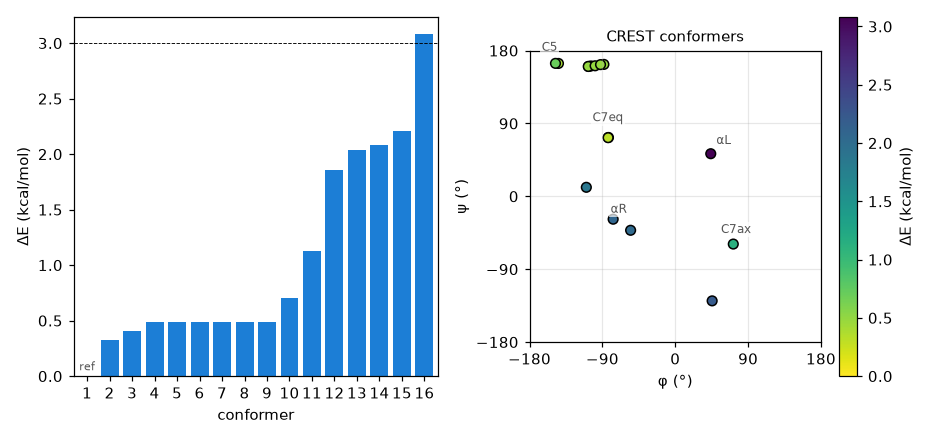
Left: relative energy per conformer, with the common 3 kcal/mol cut-off dashed. Right: the same conformers on the φ/ψ map, coloured by energy.
The populations in the table are the Boltzmann populations CREST computes from electronic energies at 298.15 K.
| Rank | ΔE (kcal/mol) | φ / ψ (°) | Region | Population (%) |
|---|---|---|---|---|
| 1 | 0.00 | −83 / 73 | C7eq | 40.1 |
| 2 | 0.32 | −83 / 72 | C7eq | 2.6 |
| 3 | 0.41 | −144 / 164 | C5 | 20.1 |
| 4 | 0.49 | −104 / 161 | β | 7.2 |
| 5 | 0.49 | −107 / 160 | β | 3.9 |
| 6 | 0.49 | −107 / 160 | β | 2.0 |
| 7 | 0.49 | −99 / 161 | β | 0.7 |
| 8 | 0.49 | −88 / 163 | β | 12.4 |
| 9 | 0.49 | −92 / 163 | β | 2.6 |
| 10 | 0.70 | −148 / 164 | C5 | 0.5 |
| 11 | 1.13 | 72 / −59 | C7ax | 4.8 |
| 12 | 1.86 | −110 / 11 | Between αR and C7eq | 1.2 |
| 13 | 2.04 | −55 / −42 | αR | 0.9 |
| 14 | 2.08 | −77 / −28 | αR | 0.05 |
| 15 | 2.21 | 46 / −129 | φ > 0, below C7ax | 0.9 |
| 16 | 3.09 | 44 / 53 | αL | 0.1 |
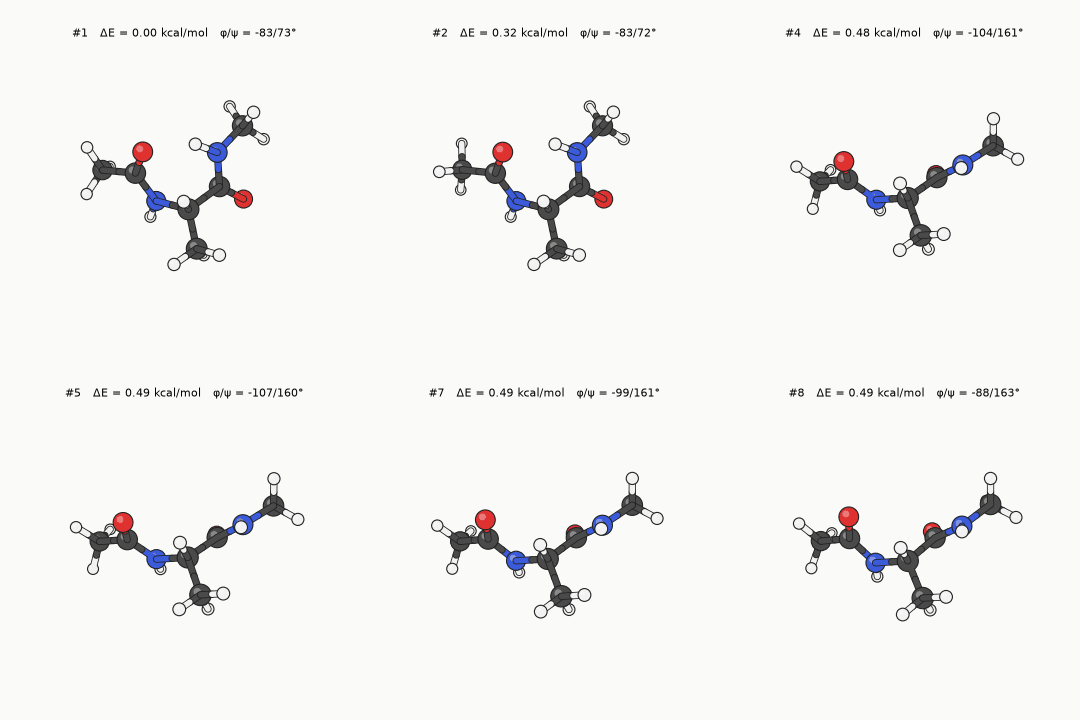
Ranks 4–9 lie within 0.004 kcal/mol of each other with nearly identical φ/ψ. Aligned on heavy atoms only, their mutual RMSD is 0.17 Å or less; the differences are mainly in hydrogen positions (methyl orientation). Ranks 3 and 10 are the same case (0.03 Å). In terms of the backbone, there are really three structures within 0.5 kcal/mol: C7eq, C5 and β. The populations include the number of rotamers of each structure, which is why ranks 1 and 2 differ by only 0.32 kcal/mol but have populations of 40% and 3%.
Compared with the previous chapter, the regions where 100 ps of plain MD spent its time (C7eq, the extended C5/β region and αR) all appear in this list, and in both cases the extended region and C7eq account for most of the weight (CREST populations: extended 49%, C7eq 43%, αR side 2%; MD: 61%, 27%, 12%). αR carries more weight in MD, which could be because the CREST populations use electronic energies without entropy, or simply because 100 ps is short. The φ > 0 structures, C7ax (rank 11), rank 15 and αL (rank 16), lie where plain MD never went. Metadynamics swept those regions, and CREST optimised structures taken from such trajectories into confirmed minima.
Common options
| Option | Meaning |
|---|---|
--ewin 6.0 | Energy window to keep (kcal/mol), default 6 |
--quick, --squick, --mquick | Reduced searches for speed; for a first pass on large molecules |
--gfnff | Search with GFN-FF; for systems of hundreds of atoms |
--gfn2//gfnff | Search with GFN-FF, then reoptimise with GFN2 |
--nci | For molecular complexes; a wall potential keeps the fragments together |
--cregen file.xyz | No search; just remove duplicates from and sort a given ensemble |
Reading the results
- Missing conformers: CREST is a stochastic search and results vary slightly between runs. For important systems, run it twice and merge.
- Energy ordering: GFN2 relative energies can be off by a few kcal/mol. Collect candidates with a generous window and set the ranking with DFT. In the next chapter, reoptimising the top 8 of this ensemble with r2SCAN-3c moves first place from C7eq to an extended (PII/β) structure, and ranks 4–8 merge into one structure.
- Free energies: the energies in
crest_conformers.xyzare electronic energies. Conformers with different vibrational entropy can swap order in free energy.