The outputs below are not illustrative — they come straight from ORCA 6.1.1. Running one
is a single line, orca water.inp > water.out. Clicking a file opens it as
text or downloads it.
Worked examples — input + real output
| Calculation | Key result | Files |
|---|---|---|
| Single point energy water · B3LYP/def2-SVP |
FINAL SPE −76.321274 Eh | input · output |
| Opt + frequencies water · with thermochemistry |
Gibbs −76.422869 Eh · 0 imaginary modes | input · output |
| DLPNO-CCSD(T) water · cc-pVTZ |
−76.331959 Eh | input · output |
| Solvation water · SMD(water) single point |
−76.332972 Eh | input · output |
| CASSCF(2,2) H2 · stretched bond (multireference) |
E(CAS) −1.056125 Eh · N(occ) 1.81/0.19 | input · output |
| Fragment merge → CASSCF(5,5) [Mn(H2O)]2+ · high-spin d5 |
N(occ) 1.00×5 (merge places d5) · −1225.0207 Eh (default-guess run) | input · merge log |
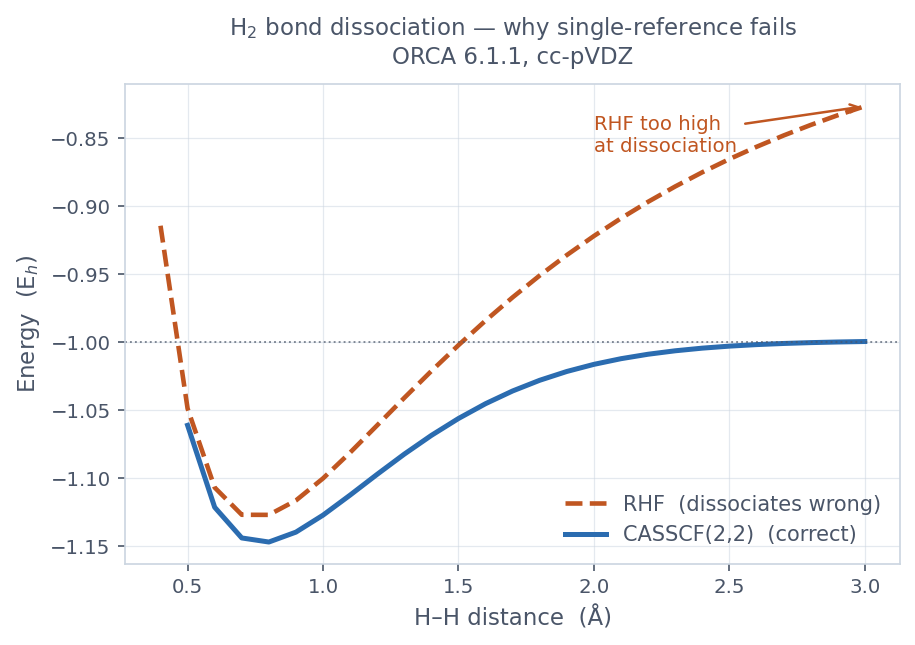
The dissociation_{rhf,cas}.dat files under 05-casscf-h2/ are the
real RHF and CASSCF curves scanned over H–H = 0.4–3.0 Å (the source for
h2-dissociation.png). RHF diverges at
dissociation, CASSCF stays well-behaved — the classic single-reference breakdown.
Fragment-merge example — 06-fragment-merge/
A real run of the split-and-merge procedure: solve the metal and the ligand separately,
then merge their orbitals with orca_mergefrag. The full walkthrough and the
gotchas are in Chapter 13, the “fragment merge” section.
| File | Role |
|---|---|
| fragMn.inp | Metal fragment — Mn2+ high-spin (sextet) |
| fragH2O.inp | Ligand fragment — H2O (UHF, to match HFTyp) |
| mergefrag.log | Real merge output — Dim 31+24=55, NEl 23+10=33 |
| super-cas-merged.inp | CASSCF(5,5) reading the merged guess |
| cas-default.inp | Reference — CASSCF from the default guess |
| cas-default.out | Converged result — E −1225.0207 Eh, N(occ) 1.0×5 |
Templates — ready-to-edit skeletons
All verified to run on ORCA 6.1.1. Swap mol.xyz for your own coordinate file.
| File | Use |
|---|---|
| single-point.inp | Single point energy |
| opt-freq.inp | Optimisation + frequencies + thermochemistry |
| solvation-smd.inp | SMD solvation single point |
| dlpno-composite-step1.inp | DFT opt+freq (D4) → writes step1.xyz |
| dlpno-composite-step2.inp | DLPNO-CCSD(T)/CBS single point (AutoAux, reads step1.xyz) |
DLPNO-CCSD(T) Extrapolate(...)dies with an “auxiliary basis required” error unless you addAutoAux.- Bundling a DFT opt (D4) and CCSD(T) in one input via
$new_joblets D4 carry into the CC step and trips a “dispersion + correlated method” abort → split the steps into separate files.