A hierarchy of functionals — Jacob's ladder
DFT functionals are often organised along Perdew's "Jacob's ladder". Each rung adds more ingredients and (typically) more accuracy at higher cost.
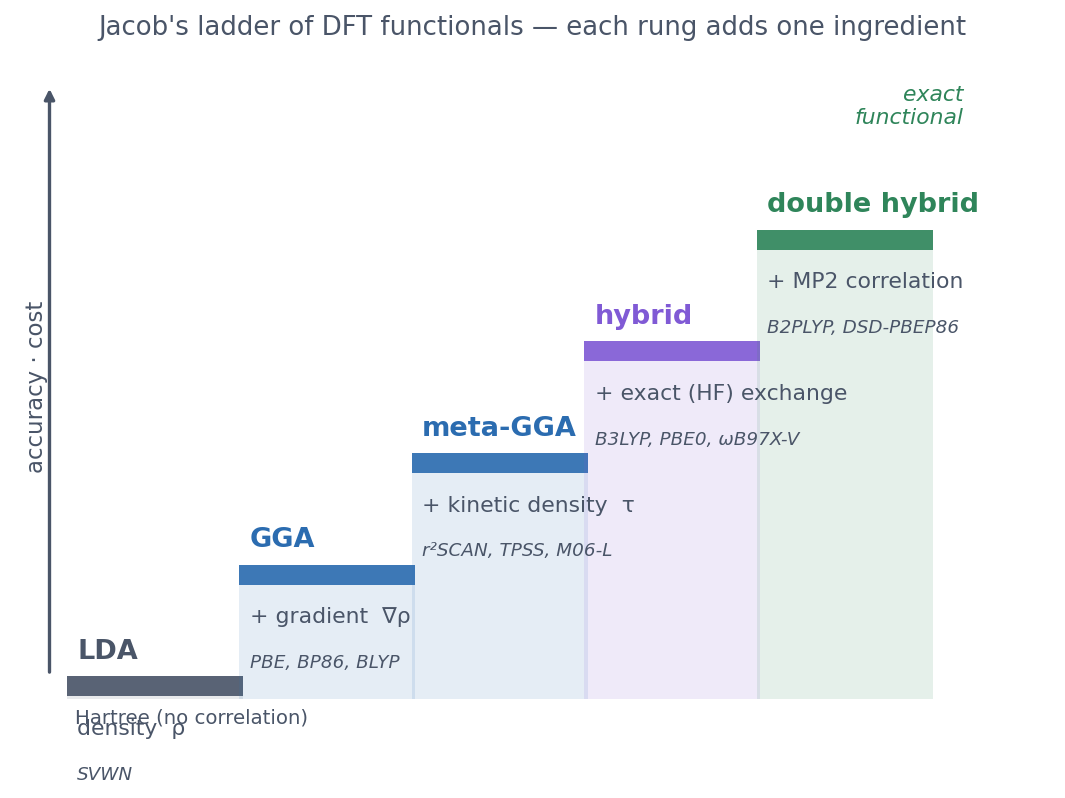
| Rung | Name | Depends on | Representative |
|---|---|---|---|
| 1 | LDA | density ρ only | SVWN — almost never used |
| 2 | GGA | ρ + ∇ρ | BP86, BLYP, PBE |
| 3 | meta-GGA | + ∇²ρ or τ | TPSS, M06-L, r²SCAN |
| 4 | Hybrid | + some HF exchange | B3LYP, PBE0, M06-2X |
| 5 | Double hybrid | + MP2 correlation | B2PLYP, DSD-PBEP86 |
Higher rungs are typically more accurate, but not always. A well-built meta-GGA (e.g. r²SCAN) can outperform a mediocre hybrid. The latest broad benchmarks (GMTKN55, MGCDB84, …) tend to rank these two functionals at the very top overall:
- ωB97M-V: meta-GGA + range-separated hybrid + VV10 non-local correlation. Overall #1.
- ωB97X-V: similar idea but GGA-based. Slightly faster.
Both are built into ORCA: ! wB97M-V def2-TZVP on one line is enough.
Dispersion corrections are essentially required
Pure GGAs and standard hybrids do not describe London dispersion. Without a correction, π–π stacking, hydrogen bonds, vdW complexes, and conformer energetics come out badly. Use one of Grimme's D3 / D4 corrections by default.
| Keyword | Description |
|---|---|
D4 | Newest. Recommended in ORCA 6. Fit for more functionals. |
D3BJ | Widely validated. Fallback if D4 is unavailable for your functional. |
D3ZERO | Alternative D3 damping. Less accurate than D3BJ. |
| (none) | ωB97M-V and ωB97X-V already include VV10, so no extra correction is needed. |
# Standard usage with dispersion correction
! B3LYP D4 def2-TZVP RIJCOSX def2/J
! PBE0 D4 def2-TZVP RIJCOSX def2/J
! r2SCAN D4 def2-TZVP def2/J      # meta-GGA doesn't need RIJCOSX

# VV10 already included — no extra correction
! wB97M-V def2-TZVP RIJCOSX def2/J
Recommendations by task
| Task | Recommended functional | Notes |
|---|---|---|
| Geometry optimisation (general organic) | r²SCAN-3c, B97-3c | Composite — basis included. |
| Geometry optimisation (TM complexes) | TPSS D4, BP86 D4 | Pure GGAs are more forgiving of poor initial geometries. |
| Reaction barriers | M06-2X D4, ωB97X-V | Higher HF percentage gives better barriers. |
| Non-covalent interactions | ωB97M-V, DSD-PBEP86 D4 | Double hybrids are the most accurate. |
| NMR chemical shifts | PBE0 D4, ωB97X D4 | Use dedicated NMR bases (pcSseg). |
| UV-Vis absorption (local excitations) | B3LYP D4, PBE0 D4 | Standard hybrids are usually enough. |
| UV-Vis absorption (charge transfer) | CAM-B3LYP, ωB97X-V | Range-separation is mandatory. |
| EPR (g-tensor, A-tensor) | PBE0, B3LYP | ~30 % HF tends to fit well. |
Composite methods (the 3c series)
The Grimme group's "3c" methods bundle "functional + basis + D3/D4 + gCP correction" into a single keyword. The basis is fixed, the usage is therefore extremely simple, and the price/accuracy ratio is hard to beat.
| Keyword | What it really is | Best for |
|---|---|---|
HF-3c | HF + minix (small DZ) + 3 corrections | Quick screening of very large molecules |
PBEh-3c | PBEh hybrid + def2-mSVP | Medium-sized opt + frequencies |
B97-3c | Modified B97 GGA + def2-mTZVP | Medium-to-large molecules, fast optimisation |
r²SCAN-3c | r²SCAN meta-GGA + def2-mTZVPP | Top recommendation. Geometries and free energies alike. |
ωB97X-3c | Range-separated hybrid + valence DZ | Organic / excited states |
# r²SCAN-3c — a strong first choice for everyday work
! r2SCAN-3c Opt Freq

* xyzfile 0 1 mol.xyzThe manual and many independent benchmarks report that r²SCAN-3c reaches B3LYP-D4/def2-TZVP accuracy in under half the time. Using r²SCAN-3c as the first attempt — and refining with more expensive methods only when needed — is an efficient workflow.
Double hybrids
Double hybrids include both HF exchange and MP2 correlation. They are one rung above the conventional hybrids in accuracy, but they inherit MP2's N⁵ scaling. Best suited to precision single-point energies.
| Keyword | Notes |
|---|---|
B2PLYP | The original double hybrid. |
DSD-PBEP86 | SCS-MP2-coupled. Excellent overall performance. |
DSD-BLYP | Strong for non-covalent interactions. |
wB97X-2 | Range-separated + double hybrid. |
PWPB95 | High accuracy, cost-efficient. |
# DLPNO-accelerated double hybrid — much cheaper
! DLPNO-B2PLYP D4 def2-TZVPP def2-TZVPP/C TightSCF

* xyzfile 0 1 mol.xyz
Recommendations by system
Organic chemistry
- Geometry optimisation:
r²SCAN-3corB97-3c. - Precision single point:
ωB97M-V/def2-TZVPP orDLPNO-CCSD(T)/cc-pVTZ. - Non-covalent interactions:
ωB97M-Vis the overall best.
Transition-metal chemistry
- First try:
TPSSh D4orTPSS D4(3d metals). - Spin-state energetics: meta-GGAs (
TPSS,M06-L) are less sensitive to the HF percentage. - Spectroscopy (g-tensor):
PBE0 D4.
Very large systems (protein active sites, MOFs)
- Start with
r²SCAN-3corHF-3c. - For QM/MM embeddings
PBEh-3ctends to be robust.
Excited states (TD-DFT)
- Local π → π*:
B3LYP,PBE0. - Charge transfer:
CAM-B3LYP,ωB97X-Vare essential. - Rydberg states: range-separated + diffuse functions.
Functionals to avoid
For historical reasons these functionals are still common, but they are not recommended for new work in the 2020s:
| Functional | Replacement |
|---|---|
SVWN / LSDA | Move up to a GGA or higher. |
B3LYP without dispersion | Always pair with D4 (or D3BJ). |
BLYP without dispersion | Same — dispersion is mandatory. |
The D2 correction | Use D4 or D3BJ instead. |
| VWN3 variants | Little effect today. B3LYP/G is for Gaussian compatibility only. |
B3LYP D4 is not the most accurate functional available today, but the overwhelming majority of the literature is written with B3LYP, so it still has value as a comparison baseline. For new work, reporting modern functionals (ωB97M-V, r²SCAN-3c, DSD-PBEP86) alongside B3LYP gives both literature consistency and higher accuracy at once.