This chapter is half of QE. A number that has not passed a convergence test is not a number, and QE will print physically wrong results in a perfectly clean format.
The standard procedure
- Converge
ecutwfc. Fix a reasonable k-grid and scan the cutoff from 20 to 80 Ry. Judge by the energy change per atom (typically within 1–5 meV/atom), not by the absolute total energy. - Converge
ecutrho. For US/PAW, fixecutwfcand scan from 4x to 12x. - Converge the k-grid. Fix the cutoffs and densify the grid. Metals need far denser grids than insulators.
- Converge
degauss(metals only). Check the behavior toward the σ → 0 limit (Chapter 06).
Convert Ry to meV/atom when judging:
$$\Delta E\,[\mathrm{meV/atom}] = \frac{|E(n) - E(n_{\max})| \times 13605.7}{N_\mathrm{at}}$$
Typical thresholds:
| Goal | Criterion |
|---|---|
| Total-energy differences (phase stability etc.) | 1–5 meV/atom |
| Forces (ML potential training data) | ~1 meV/Å per force component (≈ 2×10⁻⁵ Ry/bohr) |
Stress (before any vc-relax) |
~0.1 kbar |
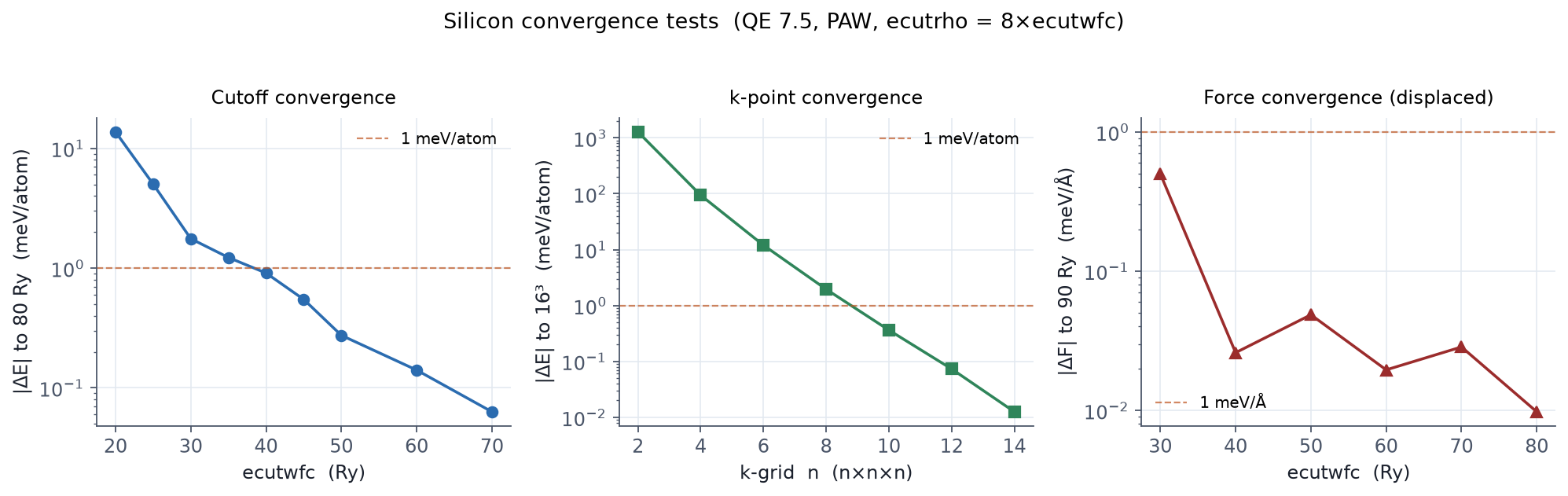
Measured: convergence behavior of PAW silicon
Below are the measured curves from Example E3,
using the bundled scripts on silicon (PAW, with ecutrho = 8 × ecutwfc
scanned together).
Common misconceptions
- Absolute total energies have a different zero for every pseudopotential, so comparing them is meaningless. Only differences computed under identical conditions matter.
- A converged energy does not imply converged forces, stress, or DOS. Verify convergence for the property you actually care about (an energy difference? forces? a band gap? a magnetic moment?). For ML training data, converge on forces.
- Monotonic convergence in the cutoff is guaranteed by the variational principle; monotonic convergence in the k-grid is not. Non-monotonic k-point behavior is normal.
Running one convergence test and declaring "this element needs 40 Ry" forever. Cutoff requirements attach to the pseudopotential file, not to the element. New potential, new test. And if a project mixes very different structures (bulk, surface, molecule), standardize on the settings demanded by the most demanding one.
Practical sense for k-grids
- In
K_POINTS (automatic), the six numbers are the Monkhorst-Pack gridnk1 nk2 nk3and shiftss1 s2 s3. A shift of1(half-step offset) can speed convergence for insulators at equal density. However, any nscf that will use the tetrahedron method must have an unshifted, Γ-centered grid. - Scale the grid inversely with cell size. Large cells (slabs, supercells) need fewer points; one point suffices along a vacuum direction.
- Metals need dense grids to resolve the Fermi surface. See the 12×12×12 in Example E5 and 16×16×16 in Example E9.
Related examples
- E3 · Automating convergence tests: this chapter's procedure, scripted and measured.
- E5 · fcc Al metal: k-point and degauss convergence in a metal.