This is the gateway to transition-metal oxides. Collinear spin polarization
is switched on by nspin = 2; the real problem is which magnetic solution
the SCF converges to.
Basic setup
&SYSTEM
  nspin = 2
  starting_magnetization(1) =  0.6   ! Fe1 (up)
  starting_magnetization(2) = -0.6   ! Fe2 (down), AFM
  starting_magnetization(3) =  0.0   ! O
  occupations = 'smearing'
  smearing    = 'mv'
  degauss     = 0.01
/
&ELECTRONS
  mixing_beta = 0.2                  ! keep it low for magnets
  mixing_mode = 'local-TF'
/

ATOMIC_SPECIES
  Fe1  55.845  Fe.pbe-spn-kjpaw_psl.1.0.0.UPF
  Fe2  55.845  Fe.pbe-spn-kjpaw_psl.1.0.0.UPF   ! same file, different label
  O    15.999  O.pbe-n-kjpaw_psl.1.0.0.UPF
starting_magnetizationis a dimensionless ratio between −1 and 1 (not μB), and it is only an initial guess. The SCF is free to change it.- To constrain the total magnetization, use
tot_magnetization(separate Fermi levels for up and down). The O₂ triplet in Example E4 does exactly this.
AFM order is built with labels
The key trick for antiferromagnetic order: register the same
pseudopotential under two labels (Fe1, Fe2) and give them opposite
initial magnetizations. Without the label split, QE treats the two Fe atoms
as symmetry-equivalent and cannot form an AFM state at all. The same
label split is needed later by DFT+U and hp.x.
Classify the converged state from two output lines:
| Order | total magnetization | absolute magnetization |
|---|---|---|
| FM | Large | About equal to total |
| AFM | ≈ 0 | Large |
| Collapsed (nonmagnetic) | ≈ 0 | ≈ 0 |
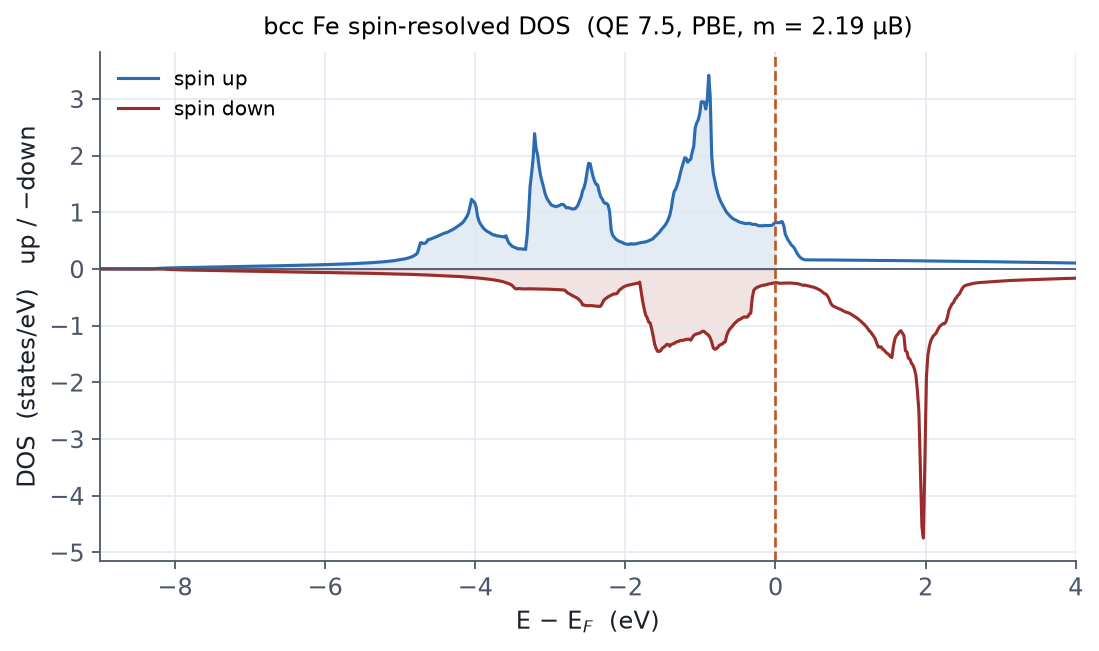
Measured: bcc Fe and FeO
Example E9 (ferromagnetic metal) and Example E10 (antiferromagnetic oxide) are this chapter in practice.
When a magnet will not converge
It is common for the magnetization to collapse to zero during the SCF. In order:
mixing_beta0.7 → 0.3 → 0.1mixing_mode = 'local-TF'- Larger
starting_magnetization(0.4–0.9) - Smaller
degauss(excess smearing erases moments). If the SCF itself fails, temporarily raise it, converge, then restart withstartingpot='file'while lowering it diagonalization = 'cg'or'ppcg'
And the fundamental caution:
Every magnetic ordering is its own metastable solution. One converged answer is not evidence of the ground state. The standard practice is to start from several initial magnetizations (FM, AFM, nonmagnetic), converge each, and pick the lowest energy.
Noncollinear magnetism and spin-orbit coupling exist behind
noncolin=.true. and lspinorb=.true. (with fully relativistic
pseudopotentials), at a much higher cost. Learn them when you need them.
Related examples
- E9 · Ferromagnetic bcc Fe: FM metal, measured moment 2.19 μB.
- E10 · FeO AFM: the AFM-II state built by the label trick, measured.
- E4 · O₂ molecule: constraining the triplet with
tot_magnetization.