Goal
Add three HUBBARD lines to the input of E10 and
turn on DFT+U. Measure what U does to the Fe-3d manifold, and then walk
into the famous trap of this system, the case where the run stays
metallic even with U on, and learn to diagnose it. Knowing this trap is
what lets you read FeO+U results in the literature critically.
New cards and variables
| Item | Role |
|---|---|
HUBBARD (ortho-atomic) |
The v7.1+ card with its projector (Chapter 13) |
U Fe1-3d 4.6 |
U (eV) per label and manifold |
starting_ns_eigenvalue |
Steering the d occupations toward a chosen minimum (see the trap section) |
Input file
Download feo_u.scf.in · scan_U.sh
The input is E10 (with prefix = 'FeO_U' so the E10 files survive) plus
this card at the very end:
! The v7.1+ Hubbard card. (ortho-atomic) picks the projector; U values are
! in eV, addressed per label and manifold. The Fe1/Fe2 label split from E10
! is what lets the two sublattices carry independent ns matrices.
! U = 4.6 eV is a conventional literature value; E12 computes 5.22 eV for
! this exact setup from first principles.
HUBBARD (ortho-atomic)
U Fe1-3d 4.6
U Fe2-3d 4.6
Computing the U proper to your own system is E12.
Run
mpirun -np 8 pw.x -nk 4 -in feo_u.scf.in > feo_u.scf.out
What to check: measured
| Item | GGA (E10) | GGA+U (this example) |
|---|---|---|
| Total energy | −741.81592 Ry | −741.52737 Ry (do not compare directly: different functionals) |
| total / absolute magnetization | 0.00 / 7.17 μB | −0.00 / 7.50 μB |
| Fe local moments | ±3.31 μB | ±3.46 μB (U strengthens the d localization) |
| Electronic structure | Metal | Still (semi)metallic: see the trap below |
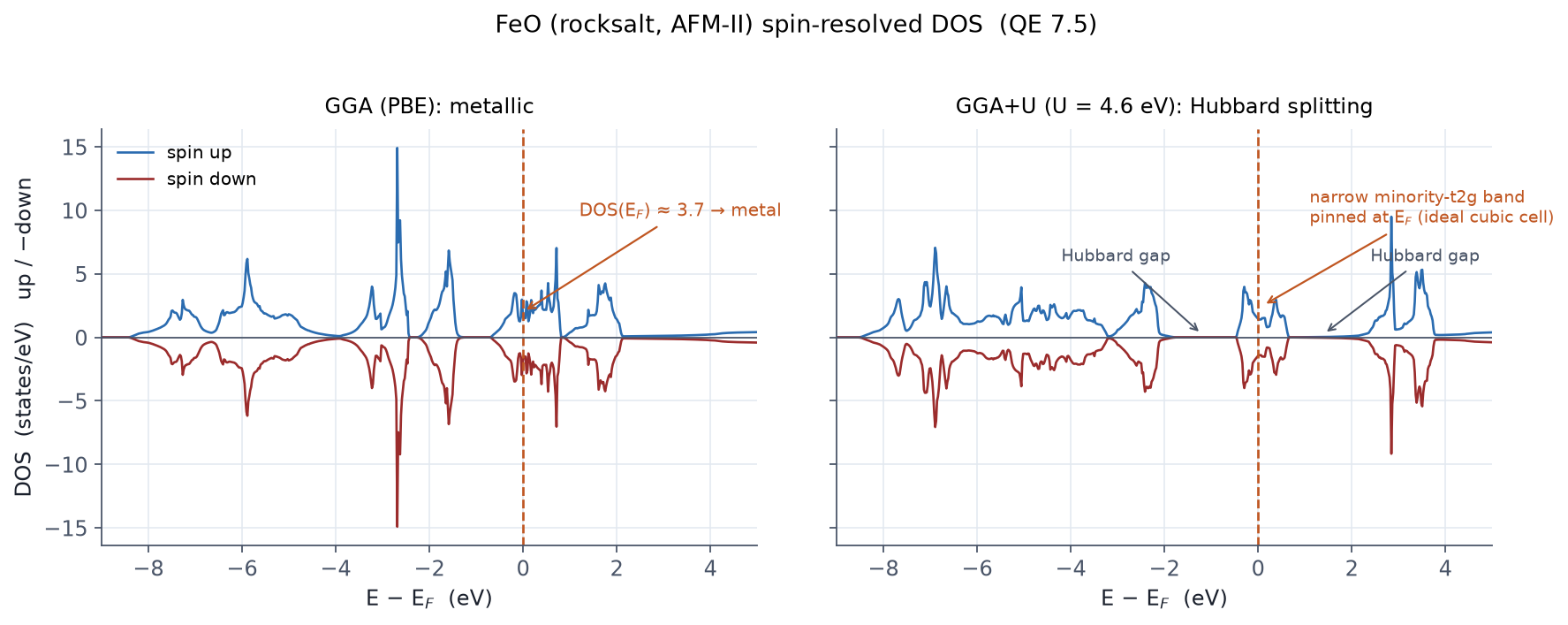
The trap: why it stays metallic with U on (with measurements)
The DOS shows U doing real work (larger moments, wide Hubbard splitting). The problem is that the single minority-spin electron of Fe²⁺ must choose among three t2g orbitals that are exactly degenerate in the ideal cubic cell. Unable to pick one, it spreads across all three and forms a narrow metallic band. Since QE 7.1 the starting d occupations are read from the pseudopotential (previously hardcoded), so the same input can land in different metallic solutions on different versions, and neither is the correct ground state (the mailing-list case cited in Chapter 13).
The standard prescription is to steer the occupations:
&SYSTEM
  ...
  starting_ns_eigenvalue(5,2,1) = 1.d0   ! Fe1: fill the top minority eigenvalue
  starting_ns_eigenvalue(5,1,2) = 1.d0   ! Fe2: mirrored spin channel
/
We report what actually happened when we tried:
- With the seed above, the SCF returned to the same metallic solution (energies agree to 4×10⁻⁷ Ry).
- A second attempt that pinned the full minority occupation pattern to
[1,0,0,0,0], with
mixing_betalowered to 0.1 anddegaussto 0.005, oscillated near 10⁻⁴ Ry for 98 iterations without converging.
In this geometry (ideal rocksalt) and setup, the metallic basin is simply
very deep. Real FeO distorts rhombohedrally along [111] below its Néel
temperature, and that distortion lifts the t2g degeneracy so that orbital
order and the insulating state settle in together. To reach the full
insulating solution you would combine (1) the experimentally distorted
structure, (2) a broader search over starting_ns_eigenvalue patterns,
and (3) the orbital-resolved DFT+U of QE 7.5 (different U for t2g and
eg, introduced for precisely this situation). A living example of
"converged does not mean correct".
Exercises
- Use scan_U.sh to scan U = 0, 2, 4, 6, 8 eV and tabulate the Fe moment and the Hubbard splitting in the DOS.
- Switch the projector between
atomicandortho-atomicat fixed U and compare. You will feel in your hands that "U comes packaged with its projector". - Add a ~3% rhombohedral distortion along [111] to
CELL_PARAMETERSand rerun with the occupation seed. Does a gap open now? - Try DFT+U+J0 by adding
J0 Fe1-3d 0.8.
Concluding "U is on and the SCF converged, so it must be an insulator
now". Always check whether the Fermi energy is disappeared
in favor of highest occupied, lowest unoccupied level, and
inspect the Tr[ns(na)] and ns eigenvalue blocks
(verbosity='high') for a physical occupation pattern.
And never compare GGA and GGA+U total energies directly; they belong
to different functionals.
Related chapters
13 DFT+U and the HUBBARD card · 14 Computing U with hp.x · 12 Spin polarization and magnetism