Why it is needed
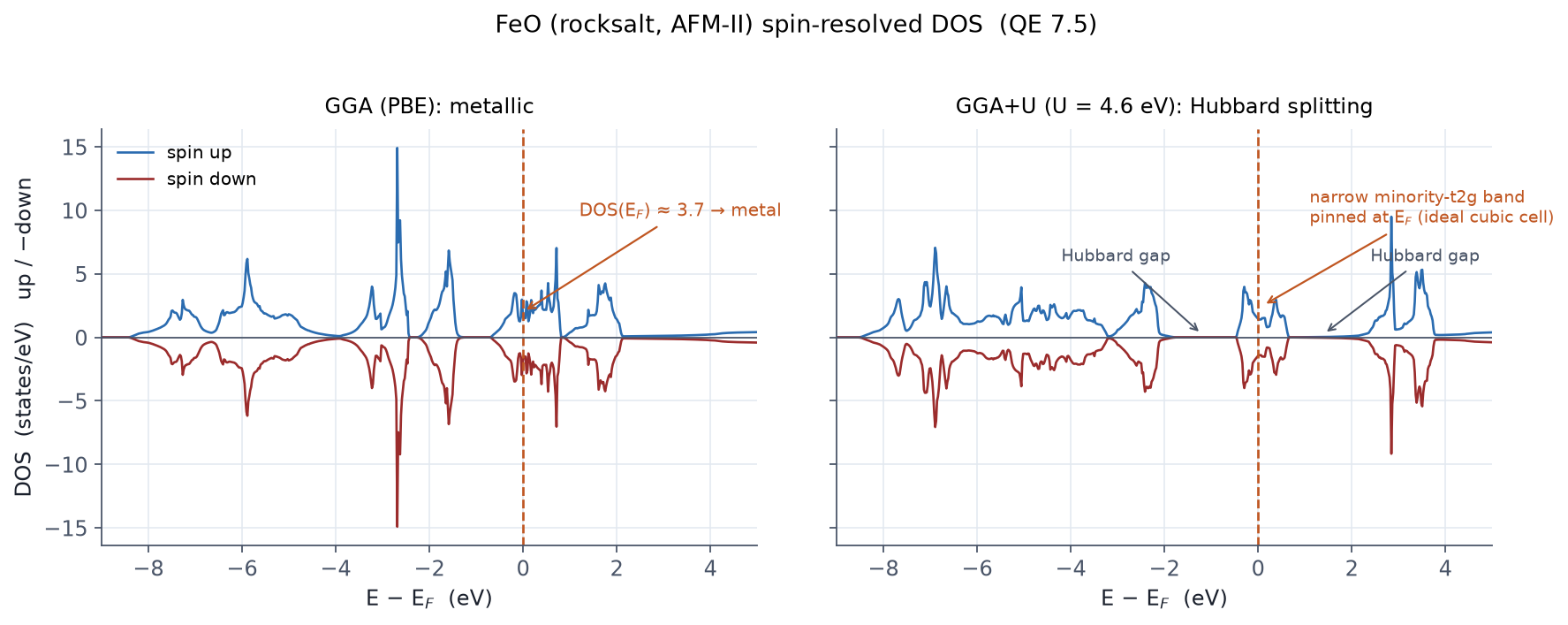
GGA mishandles the self-interaction error of localized 3d electrons. The spurious interaction of an electron with itself delocalizes orbitals that should be localized, and in systems like FeO the result is a computed metal where experiment sees an insulator (gap ≈ 2.4 eV). You can watch this failure happen in Example E10.
DFT+U adds a Hubbard correction on a chosen orbital manifold (Fe-3d, say) and repairs the error at nearly zero extra cost.
The new syntax: the HUBBARD card (v7.1+)
U parameters go in a HUBBARD card at the end of the input, not in
&SYSTEM.
HUBBARD (ortho-atomic)
U Fe1-3d 4.6
U Fe2-3d 4.6
The grammar:
HUBBARD (<projector>)
<parameter> <label>-<manifold> <value(eV)>
| Field | Options | Notes |
|---|---|---|
| Projector | atomic, ortho-atomic, norm-atomic, wf, pseudo |
ortho-atomic recommended. With atomic, the correction double-counts in orbital-overlap regions |
| Parameter | U, J0, J, B, E2, E3, V, alpha |
|
| Manifold | 3d, 2p, 4f, ... |
Up to 3 channels per atomic type |
Inter-site interactions (DFT+U+V) also take neighbor indices (numbered by
order in ATOMIC_POSITIONS):
HUBBARD (ortho-atomic)
U Fe1-3d 4.6
U Fe2-3d 4.6
V Fe1-3d O-2p  1 3  0.8
The authoritative document is Doc/Hubbard_input.pdf
(online).
The lda_plus_u = .true. / Hubbard_U(1) = 4.6 /
U_projection_type style was retired in v7.1. Much of the
internet still shows it, and pasting it gets you input that is silently
ignored or fails. The only DFT+U variables left in
&SYSTEM are starting_ns_eigenvalue and
Hubbard_occ.
Measured: what U does in FeO, and what it cannot do alone
Example E11 is the same FeO AFM-II cell with just the three HUBBARD lines added.
If it is still metallic with U on: the occupation-pattern trap
It is common to switch U on and still converge to a metal. The culprit is the occupation pattern of the d orbitals. Since QE 7.1 the initial d occupations are read from the pseudopotential (they used to be hardcoded), so the same input can converge to different metallic solutions on different versions. Both are wrong ground states (this is the mailing-list case the community knows well).
The prescription is to steer the occupations explicitly with
starting_ns_eigenvalue:
&SYSTEM
  ...
  starting_ns_eigenvalue(5, 2, 1) = 0.0d0   ! (orbital index, spin, atom type)
/
The constraint holds only for the first few SCF iterations and is then
released; think of it as a device that pushes the run into the basin of the
correct minimum. After convergence, inspect the Tr[ns(na)] values and the
ns eigenvalue blocks in the output (verbosity='high' required) to confirm
the occupation pattern is physical. This is the canonical example of
"converged does not mean correct".
U comes as a package with its projector
The same U = 4.6 eV gives different results under atomic and
ortho-atomic projectors. A U value has meaning only together with its
projector (and pseudopotential), so when borrowing U from a paper, check
the projector conventions, and when publishing, record your own. The way to
avoid borrowing altogether is to compute U for your own system:
Chapter 14, hp.x.
QE 7.5 adds orbital-resolved DFT+U (Macke & Timrov, JCTC 2024), which can assign different U values to t2g and eg within one 3d manifold. It was designed for octahedral transition-metal oxides, exactly the FeO situation.
Related examples
- E10 · FeO AFM (where GGA fails): confirm the metal without U.
- E11 · FeO with DFT+U: the HUBBARD card and the trap, measured.
- E12 · Computing U with hp.x: first-principles U.