Goal
The gateway example for antiferromagnetic oxides. Build the AFM-II order of rocksalt FeO (alternating (111) spin planes) by splitting one element into two labels, and then watch GGA (PBE) predict a metal for a material that experiment says is an insulator with a gap of about 2.4 eV. Seeing this failure with your own eyes is the motivation for E11 (DFT+U).
New cards and variables
| Item | Role |
|---|---|
ntyp=3 (Fe1/Fe2/O) |
The same UPF under two labels: the key to AFM |
starting_magnetization ±0.6 |
Fe1 up, Fe2 down |
ibrav=0 + rhombohedral magnetic cell |
2 Fe + 2 O, volume = 0.5 a³ |
mixing_beta=0.2 + local-TF |
The mixing prescription for a touchy magnetic oxide |
Input file
! E10: FeO in the rocksalt structure with AFM-II order
! (ferromagnetic (111) planes with alternating sign).
! The magnetic unit cell is rhombohedral: 2 Fe + 2 O, volume = 0.5 a^3.
! THE POINT of this run: the AFM order converges beautifully, and GGA
! still predicts a metal. Experiment says insulator, gap ~2.4 eV.

&CONTROL
  calculation = 'scf'
  prefix      = 'FeO'
  outdir      = './tmp/'
  pseudo_dir  = './pseudo/'
  verbosity   = 'high'        ! also prints the ns matrices once U is on (E11)
  tprnfor     = .true.
  tstress     = .true.
/
&SYSTEM
  ibrav       = 0             ! cell given explicitly below
  celldm(1)   = 8.18          ! cubic a in bohr (= 4.33 Angstrom); scales CELL_PARAMETERS (alat)
  nat         = 4
  ntyp        = 3             ! Fe1, Fe2, O: the label split that makes AFM possible
  ecutwfc     = 70
  ecutrho     = 700           ! the 10x Fe rule again
  occupations = 'smearing'    ! the GGA ground state is (wrongly) metallic, so smear
  smearing    = 'mv'
  degauss     = 0.01
  nspin       = 2
  starting_magnetization(1) =  0.6    ! Fe1 sublattice: up
  starting_magnetization(2) = -0.6    ! Fe2 sublattice: down  -> AFM seed
  starting_magnetization(3) =  0.0    ! O: no seed
/
&ELECTRONS
  conv_thr    = 1.0d-8
  mixing_beta = 0.2           ! touchy magnetic oxide: mix gently
  mixing_mode = 'local-TF'
  electron_maxstep = 300
/

! the SAME pseudopotential file under two labels: without this split QE
! treats the two Fe as symmetry-equivalent and no AFM state can form
ATOMIC_SPECIES
  Fe1  55.845  Fe.pbe-spn-kjpaw_psl.1.0.0.UPF
  Fe2  55.845  Fe.pbe-spn-kjpaw_psl.1.0.0.UPF
  O    15.999  O.pbe-n-kjpaw_psl.1.0.0.UPF

! rhombohedral doubling of the fcc cell along [111], in units of alat:
! these three vectors hold two rocksalt formula units, so that the two Fe
! (111) planes can carry opposite spins. det = 0.5 -> volume 0.5 a^3.
CELL_PARAMETERS (alat)
  0.5  0.5  1.0
  0.5  1.0  0.5
  1.0  0.5  0.5

! fractional coordinates: Fe at 0 and 1/2 along the cell diagonal are the
! two oppositely magnetized (111) planes; O sits between them
ATOMIC_POSITIONS (crystal)
  Fe1  0.00  0.00  0.00
  Fe2  0.50  0.50  0.50
  O    0.25  0.25  0.25
  O    0.75  0.75  0.75

K_POINTS (automatic)
  6 6 6  0 0 0
Without the label split, QE treats the two Fe atoms as symmetry-equivalent and cannot form AFM order at all. The same split is required later by DFT+U (E11) and hp.x (E12).
Run
mpirun -np 8 pw.x -nk 4 -in feo.scf.in > feo.scf.out
What to check: measured (the real point of this example)
| Item | Measured (QE 7.5, PAW) | Reading |
|---|---|---|
| Total energy | −741.81592118 Ry (28 iterations) | |
| total magnetization | 0.00 μB | AFM established |
| absolute magnetization | 7.17 μB | total ≈ 0 with large absolute: the AFM badge |
| Fe local moments | +3.31 / −3.31 μB | The alternating (111) arrangement confirmed |
| O moment | 0.00 | |
the Fermi energy is 14.2231 ev |
printed, so a metal | The GGA failure. Experiment: an insulator (~2.4 eV) |
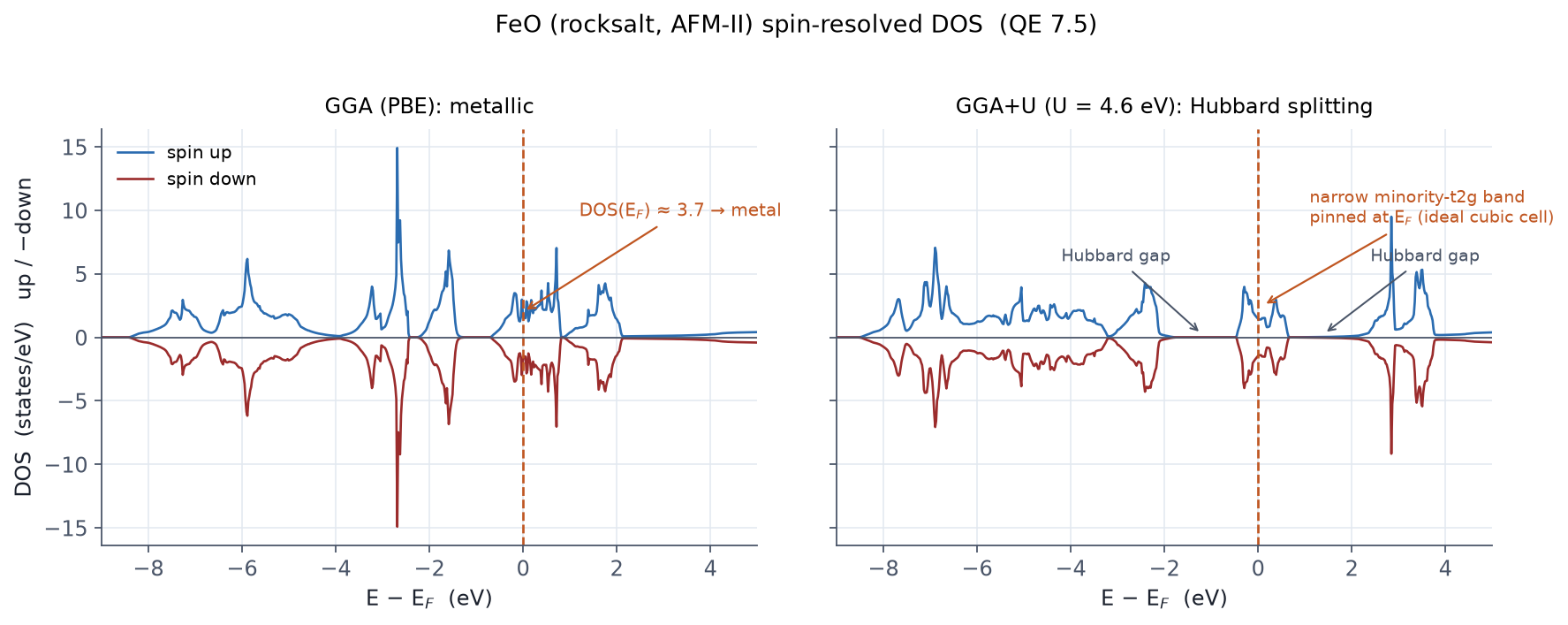
The AFM order itself came out perfectly (moments ±3.31 μB), yet the electronic structure is metallic. That is the self-interaction error of GGA delocalizing the Fe-3d electrons, and it is why the U correction exists (Chapter 13).
Exercises
- Run the PDOS pipeline of E7 and confirm that the states at the Fermi level are Fe-3d.
- Converge the ferromagnetic arrangement (both +0.6) and compare its energy with AFM. Which is the ground state?
- Verify by determinant that the cell really holds 2 formula units (volume = 0.5 a³).
- Set all
starting_magnetizationto zero. Which solution do you land in?
Keeping ntyp=2 (Fe/O) and giving ± initial moments:
atoms of one type share one initial magnetization, so no AFM forms.
And if you built "AFM" but the total magnetization is not zero,
suspect a failed label split or symmetry enforcing FM
(R3, silent failures).
Related chapters
12 Spin polarization and magnetism · 13 DFT+U and the HUBBARD card · 07 Controlling SCF convergence