Goal
Your first metal. See why occupations='smearing' is required, where
the Fermi level shows up, and measure how the smearing type and degauss
leave their fingerprints on the energy.
New cards and variables
| Item | Role |
|---|---|
occupations='smearing' |
Partial occupations for a metal |
smearing='mv' |
Marzari-Vanderbilt (cold): the metal default |
degauss |
Smearing width (Ry) |
nbnd=8 |
A generous band count |
Input file
! E05: fcc aluminium, the first metal.
! A metal has no gap, so occupations must be smeared around the Fermi level.

&CONTROL
  calculation = 'scf'
  prefix      = 'al'
  outdir      = './tmp/'
  pseudo_dir  = './pseudo/'
  verbosity   = 'high'
/
&SYSTEM
  ibrav       = 2           ! fcc
  celldm(1)   = 7.65        ! bohr (= 4.05 Angstrom, experimental)
  nat         = 1
  ntyp        = 1
  ecutwfc     = 40
  ecutrho     = 320         ! 8x rule
  occupations = 'smearing'  ! mandatory for a metal ('fixed' would abort)
  smearing    = 'mv'        ! Marzari-Vanderbilt cold smearing: free energy ~ E(sigma->0),
                            ! so no extrapolation in degauss is needed
  degauss     = 0.02        ! smearing width in Ry; converge it together with the k-grid
  nbnd        = 8           ! more bands than the default: partial occupations need headroom
/
&ELECTRONS
  conv_thr    = 1.0d-8
  mixing_beta = 0.7         ! simple sp metal: aggressive mixing still works
/

ATOMIC_SPECIES
  Al  26.9815  Al.pbe-n-kjpaw_psl.1.0.0.UPF

ATOMIC_POSITIONS (alat)
  Al  0.00  0.00  0.00

! metals need dense grids to resolve the Fermi surface;
! 12x12x12 here vs the 8x8x8 that sufficed for the Si insulator
K_POINTS (automatic)
  12 12 12  0 0 0
Run
mpirun -np 6 pw.x -nk 6 -in al.scf.in > al.scf.out
What to check: measured
| Item | Measured (QE 7.5, PAW) |
|---|---|
| Total energy | −39.50323368 Ry |
| Fermi level | the Fermi energy is 7.7450 ev: the badge of a metal |
smearing contrib. (-TS) |
The size of the smearing contamination |
Where the insulator (E1) printed
highest occupied level, the metal prints the Fermi energy is.
This line is itself the diagnosis "the run converged to a metal", and
you will meet it again with a twist in E10.
The degauss scan by smearing type: measured
The same system, scanned over smearing types (gaussian/mv/fd) and degauss (0.005 to 0.05 Ry):
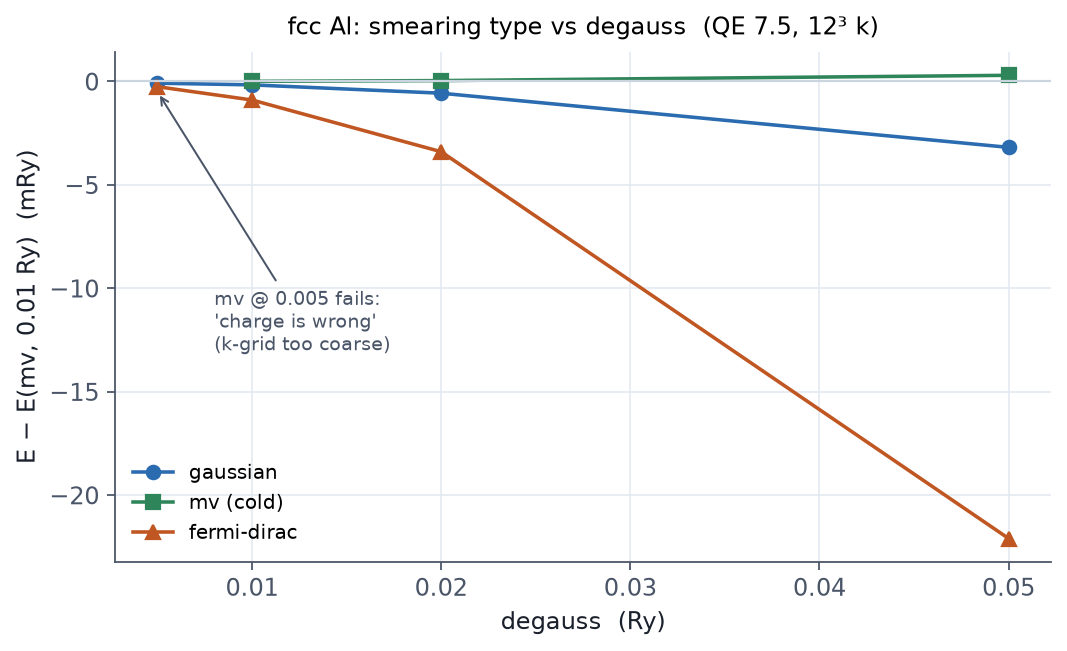
One real accident happened during the scan: mv at degauss=0.005 on the
12³ grid integrated the charge to 3.003 instead of 3 and stopped with
charge is wrong. Narrower smearing demands denser k-grids: degauss and
the k-grid are a coupled pair to converge together
(Chapter 06).
Exercises
- Sweep the k-grid from 8³ to 16³ and watch the energy scatter per degauss. Smaller degauss should demand denser grids.
- Remove
nbndand find in the output how many bands QE picks by itself. - Set
occupations='fixed'and collect the error message in person (the exact one listed in R3).
Leaving degauss large because "it converges so nicely". A large
smearing contrib. (-TS) means your result sits far from
the σ→0 limit. Always check that the property you care about is
insensitive to degauss. In magnetic metals an oversized degauss erases
the moment (E9).
Related chapters
06 Occupations and smearing · 05 Cutoff and k-point convergence