Goal
Run the density-of-states pipeline end to end: scf → nscf → dos.x →
projwfc.x. Learn in your fingers that order and matching
prefix/outdir are everything, and read the Löwdin charges at the end.
scf (8³ k) ─→ nscf (16³ k, tetrahedra) ─┬─→ dos.x       (total DOS)
                                         └─→ projwfc.x   (PDOS + Löwdin)
New cards and variables
| Item | Role |
|---|---|
calculation='nscf' + occupations='tetrahedra' |
Dense-grid eigenvalues on a frozen density (Chapter 08) |
nbnd=12 |
Enough bands to cover the conduction region |
&DOS (dos.x) |
Emin/Emax/DeltaE |
&PROJWFC (projwfc.x) |
PDOS decomposition, Löwdin |
Input files
si.scf.in · si.nscf.in · si.dos.in · si.projwfc.in · run.sh
The nscf input in full (the scf is E1's, run under the same prefix):
! E07 step 2: non-self-consistent run on a dense grid.
! Reads the frozen charge density of the scf (same prefix/outdir) and
! only recomputes eigenvalues, which is what a smooth DOS needs.

&CONTROL
  calculation = 'nscf'
  prefix      = 'si'          ! MUST match the scf
  outdir      = './tmp/'      ! MUST match the scf
  pseudo_dir  = './pseudo/'
  verbosity   = 'high'
/
&SYSTEM
  ibrav       = 2
  celldm(1)   = 10.26
  nat         = 2
  ntyp        = 1
  ecutwfc     = 30
  ecutrho     = 240
  nbnd        = 12                ! extra empty bands so the conduction DOS exists
  occupations = 'tetrahedra'      ! exact BZ integration for the DOS.
                                  ! ('tetrahedra_opt' makes projwfc.x write zero PDOS on QE 7.5)
/
&ELECTRONS
  conv_thr    = 1.0d-8
/

ATOMIC_SPECIES
  Si  28.0855  Si.pbe-n-kjpaw_psl.1.0.0.UPF

ATOMIC_POSITIONS (alat)
  Si  0.00  0.00  0.00
  Si  0.25  0.25  0.25

! the tetrahedron method requires a Gamma-centered, UNSHIFTED grid;
! 16^3 is dense enough for a smooth Si DOS
K_POINTS (automatic)
  16 16 16  0 0 0
We first ran this with the optimized tetrahedron method,
occupations='tetrahedra_opt', and found that on
QE 7.5 dos.x and the Löwdin charges are fine but projwfc.x
writes PDOS files that are entirely zero (serial or parallel,
with or without lsym). Rerunning the nscf with the classic
'tetrahedra' restores the PDOS. The distributed input
therefore uses 'tetrahedra'.
The two post-processor inputs:
! E07 step 3: dos.x sums the nscf eigenvalues into the total DOS.
! Output columns of 'si.dos': E (eV) | DOS | integrated DOS.
&DOS
  prefix = 'si'      ! same chain as before
  outdir = './tmp/'
  fildos = 'si.dos'  ! output file
  Emin   = -10.0     ! energy window in ABSOLUTE eV (not relative to E_F!);
  Emax   =  20.0     ! Si's valence bands sit near -6..+6 eV here, so this covers them
  DeltaE =  0.05     ! energy grid spacing in eV
/
! E07 step 4: projwfc.x projects the states onto atomic orbitals.
! Products: one PDOS file per atom and orbital plus the Lowdin charges
! printed at the end of standard output.
&PROJWFC
  prefix  = 'si'
  outdir  = './tmp/'
  filpdos = 'si.pdos'   ! basename of the PDOS files
  ngauss  = 0           ! 0 = plain Gaussian broadening of the projections
  degauss = 0.01        ! broadening width, in Ry
  Emin    = -10.0       ! same absolute-eV window convention as dos.x
  Emax    =  20.0
  DeltaE  =  0.05
  lsym    = .true.      ! symmetrize the projections (recommended)
/
Run
#!/bin/bash
# The whole pipeline in order; everything is glued by prefix + outdir.
set -e
pw.x       -in si.scf.in     > si.scf.out      # 1. converge the density
pw.x       -in si.nscf.in    > si.nscf.out     # 2. dense-grid eigenvalues
dos.x      -in si.dos.in     > si.dos.out      # 3. total DOS -> si.dos
projwfc.x  -in si.projwfc.in > si.projwfc.out  # 4. PDOS + Lowdin charges
grep -A20 'Lowdin Charges' si.projwfc.out      # show the per-orbital occupations
Output and figure: measured
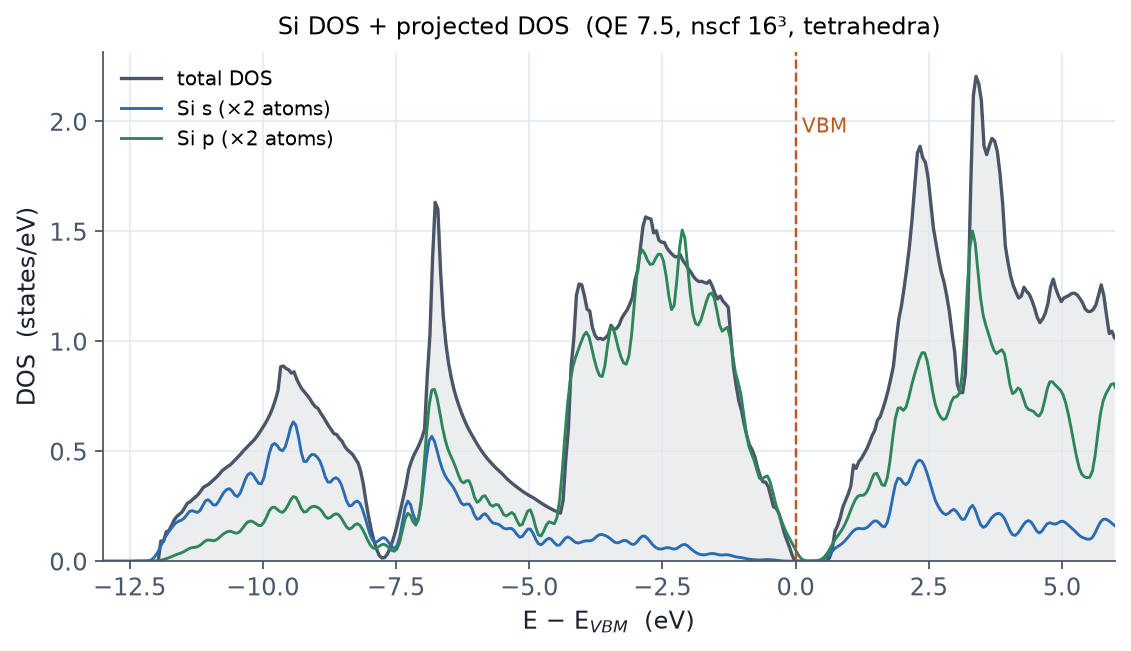
Decoding the output files:
si.dos: E (eV), DOS, integrated DOS. The integral should hit exactly 8 (the valence electron count) at the top of the valence bands: a built-in sanity check.si.pdos.pdos_atm#1(Si)_wfc#2(p): the p-projected DOS of atom 1.- Löwdin charges, measured: 3.9637 e per atom (s 1.1617 + p 2.8020), spilling parameter 0.0091. The gap to the 4 valence electrons (the spilling) is the part of the plane-wave states the atomic-orbital basis cannot represent. Keep the same caveat in mind when reading Fe d occupations and moments.
Exercises
- Sweep the nscf grid from 8³ to 24³ and watch the DOS smooth out.
- Replace
'tetrahedra'with'smearing'and see how the DOS washes out. What happens to the PDOS if you try'tetrahedra_opt'? - Verify that column 3 of
si.dos(the integrated DOS) reaches 8 at the valence-band top. - Compare the Löwdin total to the valence electron count and think about what the difference (the spilling) means.
Leaving a shift (1 1 1) on the nscf
K_POINTS: the tetrahedron method demands a Γ-centered
grid, and you get an error or quietly different numbers. And a single
character of mismatch in prefix/outdir breaks
the pipeline with cannot open file ... .save
(R3).