Goal
Start from a deliberately wrong lattice constant (10.00 bohr) and let a variable-cell relaxation find the PBE equilibrium. Learn to read a BFGS trajectory, and close with the Pulay-stress rerun rule.
New cards and variables
| Item | Role |
|---|---|
calculation='vc-relax' |
Atoms plus cell |
&IONS / &CELL |
BFGS settings, press_conv_thr |
cell_dofree='ibrav' |
Cell size only, cubic symmetry kept |
etot_conv_thr / forc_conv_thr |
Ionic-step convergence criteria |
Input file
! E06: variable-cell relaxation of silicon.
! Start from a deliberately wrong lattice constant and let BFGS find the
! PBE equilibrium. Afterwards, ALWAYS rerun scf on the final structure
! (Pulay stress: the plane-wave basis changed with the cell).

&CONTROL
  calculation   = 'vc-relax'
  prefix        = 'si_vc'
  outdir        = './tmp/'
  pseudo_dir    = './pseudo/'
  etot_conv_thr = 1.0d-5      ! stop when the energy change per ionic step is below this (Ry)
  forc_conv_thr = 1.0d-4      ! ... and every force component is below this (Ry/bohr)
  nstep         = 100         ! maximum number of ionic (BFGS) steps
  tprnfor       = .true.
  tstress       = .true.      ! vc-relax drives the stress to press_conv_thr
/
&SYSTEM
  ibrav       = 2
  celldm(1)   = 10.00         ! deliberately wrong starting value (compressed, ~+109 kbar)
  nat         = 2
  ntyp        = 1
  ecutwfc     = 40
  ecutrho     = 320
  occupations = 'fixed'
/
&ELECTRONS
  conv_thr    = 1.0d-10       ! tighter than usual: BFGS wanders on noisy forces/stress
/
&IONS
  ion_dynamics   = 'bfgs'     ! quasi-Newton optimizer for the atoms
/
&CELL
  cell_dynamics  = 'bfgs'     ! ... and for the cell
  press_conv_thr = 0.1        ! target |pressure| in kbar
  cell_dofree    = 'ibrav'    ! keep cubic symmetry: only the lattice constant may change
/

ATOMIC_SPECIES
  Si  28.0855  Si.pbe-n-kjpaw_psl.1.0.0.UPF

ATOMIC_POSITIONS (alat)
  Si  0.00  0.00  0.00
  Si  0.25  0.25  0.25

K_POINTS (automatic)
  8 8 8  0 0 0
Run
mpirun -np 6 pw.x -nk 6 -in si.vcrelax.in > si.vcrelax.out
Output and figure: measured
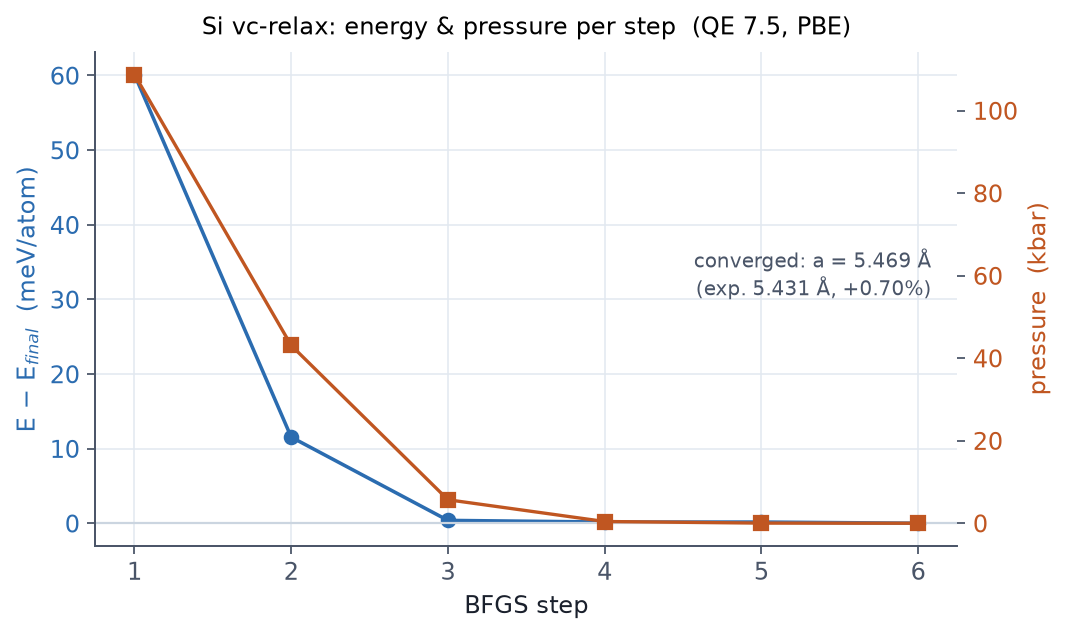
| Item | Measured |
|---|---|
| BFGS convergence | 6 SCF cycles |
| Final volume | 275.989 bohr³ = 40.897 ų (primitive cell, V = a³/4) |
| Equilibrium lattice constant | a = 5.469 Å |
| Experiment | 5.431 Å, so PBE overestimates by +0.70% |
The final cell appears in the Begin final coordinates block at the end of
the output (a CELL_PARAMETERS (alat= 10.0) matrix with scale 0.5168). The
roughly 1% lattice overestimate of PBE is a well-known systematic trend,
and here it is, measured.
The closing rule: run a fresh scf on the final structure. The
plane-wave basis changes with the cell (Pulay stress), so the energy of the
last vc-relax step was computed in the old basis
(Chapter 09).
Exercises
- Replace
cell_dofree='ibrav'with'all'. Does the final cell stay cubic? - Move one atom from (0.25, 0.25, 0.25) to (0.26, 0.26, 0.26) and check
that a fixed-cell
relaxpulls it back. - In that distorted structure, pin both atoms with
if_pos 0 0 0. What happens? - Rerun
scfon the optimized structure and compare with the last vc-relax step energy; the difference is the size of the Pulay contamination.
Running vc-relax with an everyday conv_thr
of 1.0d-6: the noisy forces and stress make BFGS oscillate. Stress is
also more cutoff-sensitive than the energy, so pass a
stress-based convergence test first.
Related chapters
09 Structure optimization · 05 Cutoff and k-point convergence